
 Home
Home Products
 Lab Reports
 News
News How To Pay
 FAQ
FAQ Contact Us
 About Us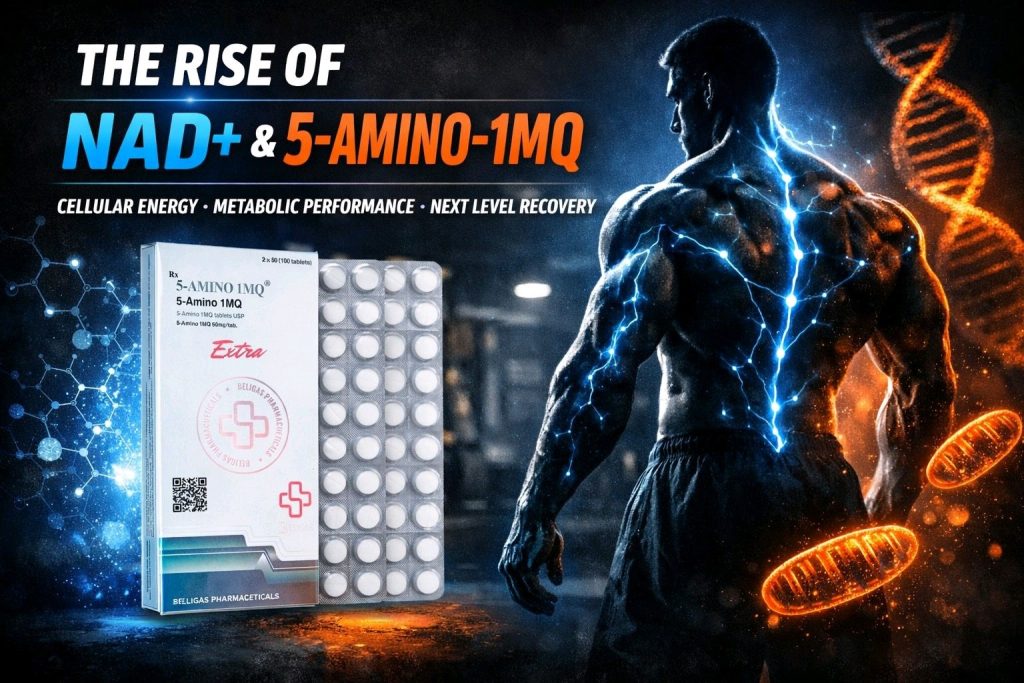
Feb
Over the last few years, NAD+ has gone from being a topic discussed mostly in aging research circles to something athletes and lifters are genuinely curious about.
The reason is simple. People are starting to care less about just pushing harder and more about how efficiently their bodies produce energy in the first place.
If performance is the output, metabolism is the engine. And NAD+ sits right at the center of that engine.
Research published in journals like Endocrine Reviews has highlighted how NAD+ levels naturally decline with age and metabolic stress. Since NAD+ plays a role in mitochondrial function, it directly connects to how effectively your cells turn nutrients into usable energy.
For anyone serious about training, recovery and body composition, that matters.
Where NMN Comes In
NMN (nicotinamide mononucleotide) became popular once human studies indexed in PubMed showed it can raise NAD+ levels in the body.
The idea behind NMN is straightforward. It acts as a precursor, meaning it provides the raw material your body can convert into NAD+. Instead of taking NAD+ directly, which has absorption challenges, NMN supports production from inside the cell.
That’s why it caught the attention of endurance athletes, strength competitors and people focused on metabolic resilience. If you can support NAD+ levels, you may be supporting the system that drives cellular energy production.
But as the conversation evolved, so did the questions.
Is Increasing Supply the Whole Story?
Once people understood that NMN could increase NAD+ availability, the next logical question was whether supply is the only factor that matters.
Research published in Scientific Reports brought attention to NNMT, an enzyme involved in diverting NAD+ precursors away from NAD+ production pathways.
In simple terms, you can increase the raw material. But if some of that material is being redirected elsewhere, efficiency becomes part of the equation.
That’s where NNMT inhibition entered the performance discussion.
NMN vs NNMT Inhibition
NMN focuses on increasing the availability of NAD+ precursors. It’s about adding more to the system.
NNMT inhibition, on the other hand, focuses on protecting what’s already there. Instead of increasing input, it aims to reduce diversion and improve how efficiently the body uses its own building blocks.
Both approaches revolve around the same pathway, but they address it from different angles. One increases supply. The other looks at utilization.
For athletes who already have their basics dialed in, that distinction becomes interesting.
Where 5-Amino-1MQ Fits
Beligas 5-Amino-1MQ 50mg (100 Tabs) has gained attention in this context because it interacts with NNMT pathways rather than acting as a direct NAD+ precursor.
In performance circles, it’s discussed as part of a broader strategy around metabolic efficiency, especially during phases where body composition, recovery and energy output are priorities.
This isn’t about stimulation or quick fixes. It’s about understanding how the underlying system works and looking for ways to support it intelligently.
That shift toward pathway-level thinking is why compounds like this are being mentioned more frequently among serious lifters and biohackers.
The Bigger Picture
The trend around NAD+, NMN and NNMT modulation reflects something larger happening in fitness.
People are moving beyond surface-level supplements and asking deeper questions about energy production, recovery and metabolic resilience. They’re reading research, following the science and experimenting thoughtfully.
NAD+ support opened the door. NMN expanded the conversation. NNMT inhibition refined it further.
For those who train hard and think long-term, understanding these pathways is part of evolving your approach.
Disclaimer
This product is intended for research purposes only. It is not intended to diagnose, treat, cure, or prevent any disease. Always conduct independent research and consult qualified professionals before introducing new compounds into your routine.
